Is Functional Medicine Legitimate? Evidence, Doctors, and Care
Functional medicine can be legitimate, but the answer to “Is functional medicine legitimate?” depends on the practitioner’s credentials and the evidence supporting the care. In the United States, functional medicine certification does not grant a practitioner additional legal authority, and the evidence behind different approaches varies.
If you’re looking for answers to ongoing symptoms, it makes sense to want more than a label or a promise. Functional medicine considers health patterns and possible root causes, but responsible care still relies on sound clinical judgment, clear reasoning, and attention to safety.
This article explains what functional medicine practitioners do, what research can and can’t tell us about the approach, and how medical licensure differs from additional training. You’ll also learn what to consider when evaluating a practitioner and whether personalized, root-cause care may suit your needs.
Table of Contents
What Is a Functional Medicine Doctor?
“Functional medicine doctor” describes an approach to care, not a separate medical license. It looks beyond an isolated symptom and considers how health history, daily habits, and body systems may be connected. For example, a practitioner may discuss sleep and nutrition alongside symptoms. The aim is a fuller picture, not a different legal status.
In the United States, MDs and DOs may pursue functional medicine training after medical school. The Institute for Functional Medicine offers additional certification to practitioners who complete its program. This education can provide tools and a framework for considering health concerns, but it does not replace a physician’s medical training or license.
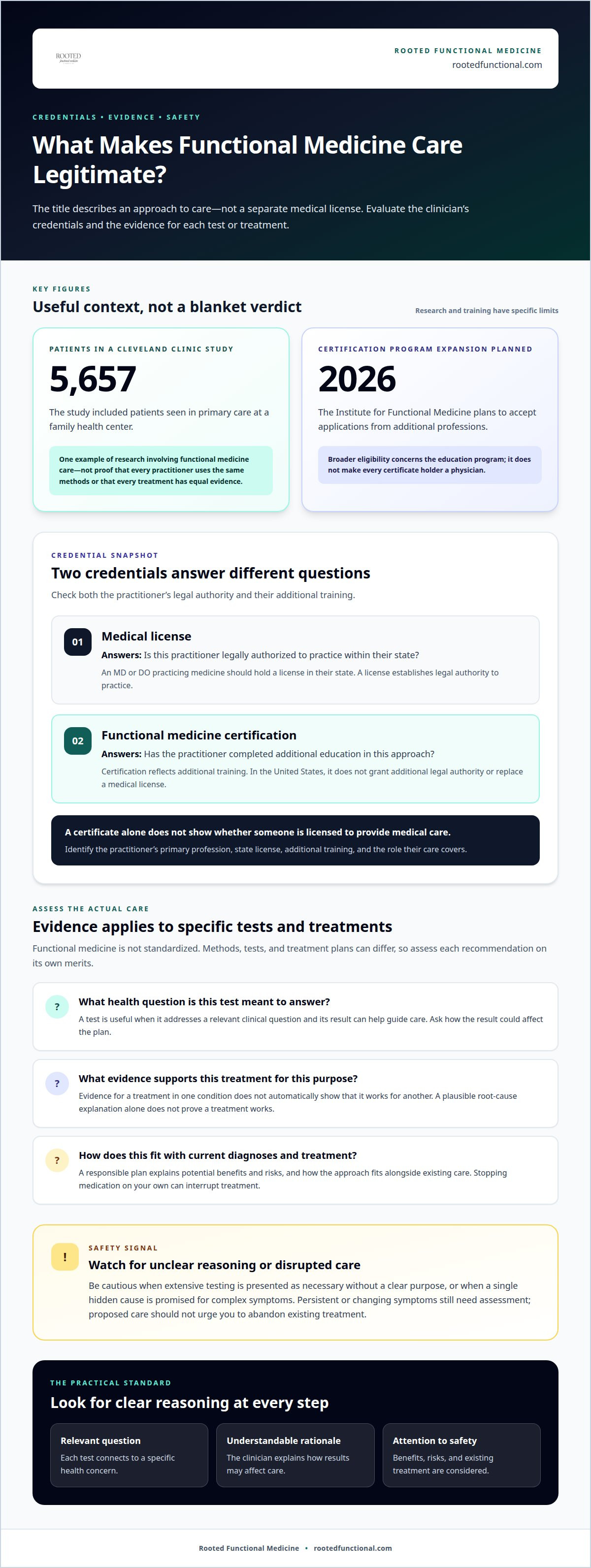
Certification and licensure answer different questions. A medical license establishes a practitioner’s legal authority to practice within their state. Functional medicine certification reflects additional education in that approach. It does not grant additional legal authority in the United States. A certificate alone, therefore, does not show whether someone is licensed to provide medical care.
Credentials can also vary by profession. The Institute for Functional Medicine plans to broaden its certification program in 2026 to accept applications from additional professions. That change concerns eligibility for its educational program. It doesn’t mean every person with functional medicine training is a physician, or that every certificate represents the same underlying clinical credentials.
This distinction matters when care involves diagnosis or treatment. An MD or DO practicing medicine should hold a license in their state. A functional medicine certificate is additional training, not a substitute for that license. Ask what kind of clinician is providing care and what their role covers. A physician’s medical degree and state license are separate from an additional certification.
Research also examines care delivered in functional medicine settings. A Cleveland Clinic study included 5,657 patients seen in primary care at a family health center. That patient group offers one example of research involving functional medicine care. It doesn’t establish that every practitioner uses the same methods, or that every treatment choice has equal evidence behind it.
Treat the title as a starting point, not a complete credential. Identify the practitioner’s primary profession, state license, and any additional functional medicine education. Then consider how they explain their clinical reasoning. A clear explanation, for instance, connects a proposed test or care plan to a specific health concern. This helps clarify what the title and certification do, and do not, establish.
Scientific evidence and legitimacy of functional medicine
Evidence varies because functional medicine is not standardized, and practitioners may use different tests and treatments. Assessing a specific intervention matters more than judging the approach by its label.
Evidence-Based Care
Evidence-based care draws on relevant research, clinical judgment, and a person’s circumstances to guide decisions. A plausible root-cause explanation does not by itself show that a proposed treatment works. A clear care plan links each test or intervention to a specific health question, explains how the result could affect care, and weighs potential benefits against risks.
There is no single functional medicine protocol that makes every practitioner’s care equivalent. One clinician might recommend a standard test for a specific symptom; another might suggest a broad panel or an unproven protocol. Assess the evidence for each choice rather than assuming it is strong because the care is called functional medicine.
Evidence for Treatments and Tests
Clinical evidence applies to specific treatments and tests, not to functional medicine as a whole. A test is useful when it can answer a relevant clinical question and its result can help guide care. A treatment needs evidence for the condition and purpose it addresses. A broad testing panel or personalized protocol is not evidence-based simply because it is part of functional medicine.
Ask how a test result would affect the care plan. If a test cannot change the next clinical decision, its value may be limited. Likewise, evidence that supports a treatment for one condition does not automatically show that it works for another. Functional medicine methods vary, and some may have limited scientific evidence or carry risks.
Risks of Care and Delayed Diagnosis
Risks arise when a plan delays appropriate evaluation or replaces prescribed treatment without coordination. Persistent or changing symptoms still need assessment. Stopping medication on your own can interrupt care for the condition it treats. A practitioner should explain how a proposed approach fits with existing diagnoses and treatment, not urge you to abandon them.
Be cautious of claims that promise a single hidden cause for complex symptoms or present extensive testing as necessary without explaining its purpose. The practical question is whether each recommendation has a clear rationale, an understandable benefit, and a safe place alongside your existing care. If you want to discuss a proposed approach in the context of your health history, you can book a care discussion.
Conditions treated and preventive care
Functional medicine practitioners often focus on chronic conditions and may also offer preventive care. They consider how diet, activity, sleep, and stress relate to a person’s health. For someone experiencing ongoing fatigue or digestive concerns, a discussion might cover symptom patterns, daily routines, and health history. These details help frame the questions explored during care.
Chronic conditions can involve several health concerns at once. Someone with an autoimmune condition, for example, may want to discuss symptoms, daily function, and lifestyle alongside medical treatment. A functional medicine practitioner may consider those factors together rather than focusing on a single complaint. The aim is to understand the broader picture and identify relevant areas for further evaluation.
Type 2 diabetes is another example of a chronic condition that can involve broader health habits. A care conversation may include eating patterns, movement, sleep, stress, and the person’s medical history. Those topics can help clarify which parts of daily life belong in an individualized plan. They don’t replace the need to address the diagnosed condition itself.
Weight concerns can also involve interconnected questions. A practitioner may explore eating routines, activity, sleep quality, stress, and other health issues that affect a person’s goals. Someone struggling to maintain changes, for instance, may need a plan that accounts for their schedule and symptoms, not just a generic diet recommendation. The focus is on relevant factors and sustainable changes.
Preventive care focuses on supporting health before a specific problem becomes the main concern. A practitioner may discuss daily habits, existing risk factors, and personal health history to identify useful areas to address. Reviewing sleep and activity patterns, for example, can make a prevention conversation more specific than general advice to “live healthier.”
A broader perspective does not mean every symptom points to one hidden cause. An assessment should connect reported concerns with relevant history and clinical findings. If someone reports joint pain, for example, the discussion might cover when it began, what affects it, and how it changes daily activities. This context helps shape appropriate questions and next steps.
The same lifestyle factor can matter differently for different people. A sleep routine may be central to one person’s wellbeing, while another may need to focus on food patterns or stress. A useful plan identifies the factor being addressed, explains how it relates to the person’s concern, and gives the change a clear purpose. That makes personalization practical, not just a label.
Functional medicine may suit people seeking a broader perspective on chronic health concerns or prevention. Its scope depends on the practitioner’s training and the person’s needs. A thoughtful approach considers daily habits alongside the person’s medical picture and shows how each concern fits into a coherent plan.
Credentials and licensure of functional medicine practitioners
Evaluate claims by identifying the practitioner’s profession, state medical license when applicable, and relevant training. Look for explanations that connect tests and care to your health concerns, rather than relying on sweeping promises.
In the United States, MDs and DOs who practice medicine should hold a license in their state. Functional medicine education is additional training, not a substitute for a medical license. This distinction separates a physician’s legal authority to practice medicine from a certificate showing study in a particular approach.
DOs have medical education and credentials similar to MDs. They complete residencies, can prescribe medication, and are licensed to practice medicine in their state. The letters DO identify a physician with a distinct medical degree, not a lesser level of clinical training. Functional medicine certification is a separate credential added to that professional background.
Training labels can mean different things. The Institute for Functional Medicine is one organization that offers functional medicine certification. A course certificate indicates that a practitioner completed the program’s requirements. It does not establish a medical degree, a state medical license, or that all practitioners have the same training. Ask what the credential represents in the clinician’s professional role.
Accreditation is another detail, but it should not be confused with licensure. Some, but not all, functional medicine courses are accredited by the American Association of Family Physicians. That describes certain courses, not every program or practitioner. Course accreditation also does not answer whether a clinician holds the professional license relevant to their work.
A practical way to assess credentials is to distinguish these parts:
Profession: Identify whether the clinician is an MD, DO, or another type of practitioner.
License: For an MD or DO practicing medicine, confirm that a state medical license applies.
Additional training: Ask what functional medicine course or certification the clinician completed.
Course accreditation: Treat accreditation as information about a course, not proof of a medical license.
Claims deserve the same careful scrutiny as credentials. A responsible explanation names the health concern, explains why a test or treatment is being considered, and clarifies how the results could affect the plan. “This test will reveal every root cause” is a sweeping claim. A specific explanation instead links a test to a defined clinical question.
Notice how a practitioner discusses your existing care. A clear conversation should explain how recommendations fit with your diagnoses and prescribed treatment. Be wary of pressure to stop medication or accept a costly plan before its purpose is explained. Credentials matter, as does the clinician’s willingness to explain decisions plainly and respect your medical history.
Personalized, root-cause approach to chronic illness
A root-cause approach asks how a person’s health history, symptoms, and daily context may connect. Rather than treating each concern separately, a practitioner considers the overall pattern. Someone with recurring digestive discomfort, for example, may discuss when it occurs, what else changes alongside it, and how it affects daily life. The aim is to shape useful questions, not assume a single hidden cause.
Personalized care starts with the person’s story. A practitioner may review symptom timing, previous diagnoses, family history, medications, diet, sleep, activity, and stress. These details add context to the clinical picture. Two people experiencing fatigue, for instance, may have different histories and priorities, so their evaluations should not automatically follow the same template.
Testing may add useful information when it addresses a specific question. Functional medicine practitioners may use blood tests, allergy tests, and genetic testing. Each test should relate to the person’s concern and have a clear role in decision-making. A result is one part of an assessment, not a complete explanation on its own.
A careful process links each step:
Describe the concern: Record what the person experiences and how it affects daily activities.
Consider context: Review relevant health history and lifestyle factors alongside current care.
Choose an evaluation: Use a test when it can address a defined clinical question.
Revisit the plan: Consider findings alongside symptoms and the person’s response to care.
This approach can help people who feel their ongoing symptoms have been considered one at a time. It creates space to discuss connections across health history and daily life. Still, “root cause” should not promise that every complex condition has one discoverable explanation. A sound approach distinguishes a possible contributor from a proven cause and explains how that difference affects the plan.
Personalized care also means recommendations should suit a person’s circumstances. A plan involving food changes, for example, should account for their routine and health needs rather than rely on a generic rule. Lifestyle factors can inform care, but they do not remove the need to consider diagnosed conditions and existing treatment.
For persistent symptoms, a Root Cause Consultation can provide a focused setting to discuss health history and questions about next steps. Root Cause Consultation and Neuropathy Root Cause Testing address different needs: a consultation focuses on the broader discussion, while neuropathy testing relates specifically to investigating neuropathy’s possible causes. Matching the evaluation to the concern keeps personalization grounded in a clear purpose.
Rooted Functional Medicine
Rooted Functional Medicine offers a next step for people seeking a personalized, root-cause perspective on chronic health concerns. Its care uses lab-based, integrative protocols to explore factors that may contribute to ongoing symptoms. A Root Cause Consultation can help frame those questions, while condition-focused options include the Autoimmune Solutions Program and Type 2 Diabetes Reversal Program. The right starting point depends on the health concern you want to address.
If you’re still looking for a clearer way to understand persistent symptoms, you don’t have to sort through the questions alone. Contact Rooted Functional Medicine to discuss a possible next step.
Choose a Thoughtful Next Step
If you’re asking whether functional medicine is legitimate, focus on the care itself: clear reasoning, relevant evidence, and respect for your health history. You deserve to understand why a recommendation is being made and how it fits with your existing care. That clarity can help you decide whether a root-cause approach suits your needs.
Rooted Functional Medicine offers support through the Healing Neuropathy Webinar, Root Cause Consultation, and Autoimmune Solutions Program. Each addresses different concerns. A Root Cause Consultation is a practical starting point to discuss your health history and main concerns with Dr. Adrienne Guthrie, then consider an appropriate next step.
You don’t need to have every answer before reaching out. Start with the concern you want to understand, and take the next step at your own pace. Contact Rooted Functional Medicine to discuss your options and move forward with greater clarity.
Frequently Asked Questions
What is functional medicine, and how does it differ from conventional medicine?
Functional medicine takes a personalized, whole-person approach, while conventional care often starts with a diagnosis and treatment for a defined condition. The approaches can overlap. Someone with persistent headaches, for example, might discuss symptom patterns and daily routines alongside medical evaluation. Legitimacy depends less on the label than on the practitioner’s credentials and whether specific recommendations have a sound clinical basis.
What does scientific evidence say about functional medicine’s effectiveness?
Evidence for functional medicine is not uniform because practitioners may use different methods, tests, and treatments. Findings about one program or intervention do not automatically establish that another works. For a specific recommendation, look for a clear connection between your health concern, the proposed approach, and a meaningful clinical reason for using it. Be cautious of broad claims that promise to explain or resolve many unrelated symptoms.
Do functional medicine doctors have recognized medical licenses or board certifications?
Some functional medicine practitioners are physicians, while others have different professional backgrounds. In the United States, MDs and DOs who practice medicine should hold a state license. Functional medicine certification is additional training; it does not grant medical licensure or establish board certification. Ask about the practitioner’s primary qualification, what their functional medicine credential represents, and which services they are qualified to provide.
How can I verify a functional medicine practitioner’s credentials in the United States?
Start by asking for the practitioner’s full professional title and the name of any certification program they completed. For an MD or DO, confirm their state medical license through the relevant state licensing authority. Treat a functional medicine certificate as additional education, not a substitute for that license. Ask for a plain-language explanation of proposed tests and care, including how each recommendation relates to your specific concern.
How does functional medicine compare with evidence-based integrative medicine?
The terms can overlap, and neither label proves that every treatment is supported by evidence. Compare individual recommendations: what concern does each address, what evidence supports it, and how does it fit with other care? A lifestyle change, for instance, may complement medical treatment, while a specialized test needs a clear purpose. Assess the specific method, not just the name of the approach.
What do major medical organizations say about functional medicine?
There isn’t one institutional statement that validates every functional medicine practitioner or method. Cleveland Clinic opened a Center for Functional Medicine in 2014, showing that a major health system established a center devoted to this approach. That fact doesn’t prove every functional medicine treatment is effective. The more useful question remains whether a particular practitioner’s recommendations have a clear clinical rationale and evidence relevant to your needs.