Adrenal fatigue recovery: treatment and possible ways to help
An adrenal fatigue recovery plan centers on steady sleep, stress management, balanced meals, and movement suited to your energy. Recovery can take from 3 months to 3 years, so a quick fix or supplement alone is unlikely to address the whole picture. A thoughtful plan also considers whether another health issue could be contributing to persistent exhaustion, brain fog, or disrupted sleep.
If you’re worn down and struggling to feel like yourself, it can be frustrating to hear that stress is the answer without a clear explanation of what to do next. The goal is to look beyond the label and understand how chronic stress, daily habits, and other possible causes may be affecting how you feel.
This article explains common approaches to adrenal fatigue recovery, what changes people may notice, and where supplements fit. You’ll also learn why gradual, personalized changes are more useful than trying to force your energy back all at once.
Table of Contents
Can supplements speed up my recovery?
Supplements may support a broader recovery approach, but they cannot replace balanced meals, sleep, and stress management. An adrenal fatigue recovery plan works best when nutrition and supplements are considered alongside symptoms, existing medications, and individual needs.
Herbal and Nutritional Supplements
Herbal and nutritional supplements include adaptogens, vitamins, and minerals that may be used as part of a nutrition plan. Ashwagandha and rhodiola are adaptogenic herbs sometimes used to support the body’s response to stress, while magnesium is another nutrient that may be considered. Supplements can affect the body and interact with medications, so choosing them based on symptoms alone can be risky.
Why can adrenal support supplements or steroid use be dangerous? Supplements can interact with medications or provide nutrients a person doesn’t need, and steroid use without medical supervision can interfere with the body’s own cortisol production. Don’t assume “adrenal support” means a product is harmless. Review ingredients and use with a qualified health professional.
Diet, Exercise, and Nutrients
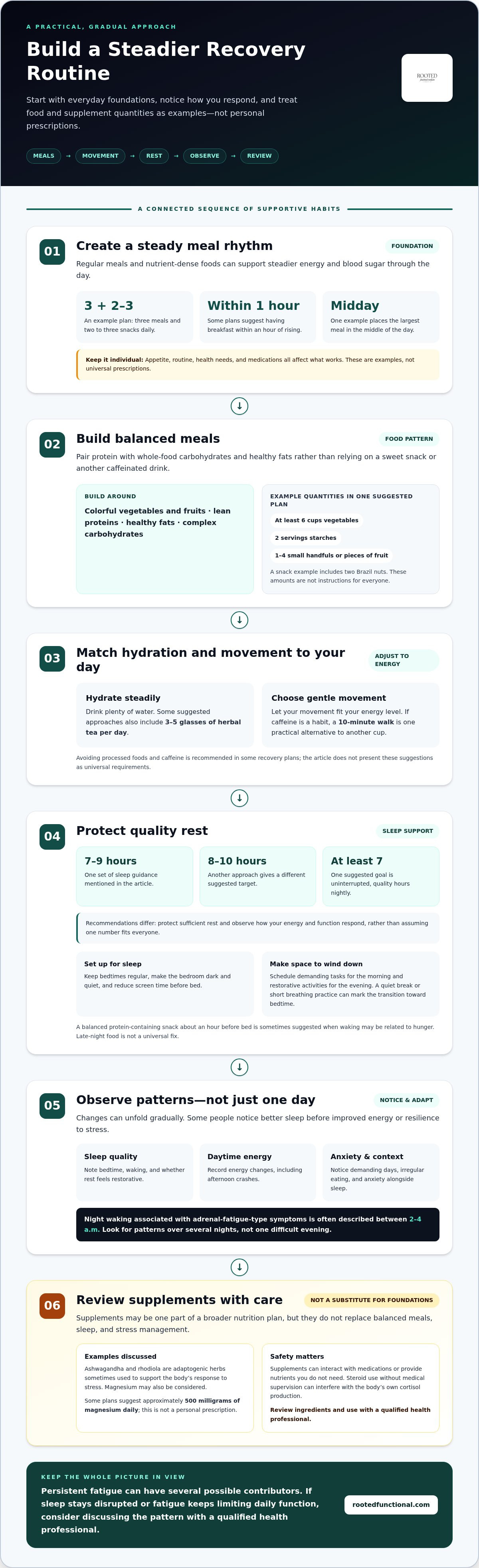
A nutrition-focused recovery plan may include regular meals, nutrient-dense foods, hydration, and movement suited to your energy. These habits can support steadier energy and blood sugar through the day. For example, pair protein with whole-food carbohydrates and healthy fats rather than relying on a sweet snack or another caffeinated drink.
Some suggested meal plans include three nutritious meals and two to three snacks daily, with breakfast within an hour of rising. They may place the largest meal in the middle of the day. These are examples, not universal prescriptions. Appetite, routine, health needs, and medications all affect what works for an individual.
Build meals around colorful vegetables and fruits, lean proteins, healthy fats, and complex carbohydrates. One suggested plan recommends at least 6 cups of vegetables per day, 2 servings of starches, and 1 to 4 small handfuls or pieces of fruit. A snack might include two Brazil nuts. These quantities are examples, not instructions for everyone.
Hydration and exercise also matter. Suggested approaches include plenty of water, 3 to 5 glasses of herbal tea per day, and gentle movement matched to energy levels. Avoiding processed foods and caffeine is another recommendation in some recovery plans. If caffeine is a habit, a 10-minute walk offers one practical alternative to another cup.
Some plans suggest approximately 500 milligrams of magnesium daily, but that amount shouldn’t be treated as a personal prescription. A nutrition plan should account for existing supplements, medicine, food intake, and symptoms. Focus first on a balanced pattern of meals and movement, then consider whether targeted nutrients have a clear role.
Reported energy, sleep, and anxiety changes
Changes during recovery may unfold gradually rather than appearing all at once. Some people notice better sleep before they notice improved energy or resilience to stress.
Sleep and Energy Limits
Sleep and daytime energy can change at different rates during recovery. Feeling more rested doesn’t always mean your energy has fully returned. You might sleep more consistently yet still struggle through an afternoon. Track sleep quality, daytime energy, and anxiety separately for a clearer picture than one good morning can provide.
Night waking associated with adrenal-fatigue-type symptoms is often described between 2-4 a.m. Returning afternoon energy crashes, disrupted sleep, salt or sugar cravings, and heightened emotional sensitivity can also signal that symptoms are flaring again. Notice when these patterns occur, and whether they follow poor sleep, demanding days, or irregular eating.
Sleep Recommendations and Rest
Sleep recommendations focus on enough quality rest, a regular bedtime, and an environment that supports sleep. Suggested targets differ: some guidance recommends 7-9 hours per night, while another approach suggests 8-10 hours. The useful takeaway is to protect sufficient rest and observe how your energy and function respond, rather than treating one number as right for everyone.
One suggested goal is at least seven hours of uninterrupted, quality sleep each night. Create a dark, quiet bedroom, keep bedtimes regular, and reduce screen time before bed. These steps make rest a deliberate part of recovery, rather than whatever time remains after work and household tasks.
A snack an hour before bed is one strategy sometimes suggested for people whose nighttime waking may be related to hunger. Choose a balanced snack that includes protein rather than relying on a sugary snack alone. Regular eating can support steadier blood sugar, but late-night food isn’t a universal fix for waking. Note whether a snack changes your sleep, and don’t let vitamins or supplements stand in for rest.
Protect recovery time during the day, too. Schedule demanding tasks for the morning and restorative activities for the evening, when energy may be lower. A short breathing practice or quiet break can help mark the transition between work and bedtime. If anxiety rises at night, write down the next day’s tasks before winding down instead of trying to solve them in bed.
Look for patterns over several nights, not one difficult evening. A simple record of bedtime, waking, afternoon energy, eating, and anxiety can reveal connections that are easy to miss. If sleep remains disrupted or fatigue keeps limiting daily function, scheduling a consultation with Rooted Functional Medicine can be a practical next step as part of your personalized adrenal fatigue recovery plan.
How is Adrenal Fatigue Treated?
Care may focus on reducing ongoing stress and supporting sleep, daily function, and resilience. Persistent fatigue also deserves a broader evaluation, since several health issues can cause similar symptoms.
Stress Management and Resilience
Stress management means building regular practices that help you recover from pressure instead of staying in a constant cycle of strain. Daily stress can affect sleep, energy, and your ability to manage ordinary demands. Options include deep breathing, mindfulness, journaling, yoga, and spending time outdoors. Choose something you can repeat consistently, such as a short breathing break between work tasks.
A suggested goal is 20 to 30 minutes of daily meditation, but smaller practices can also fit into a busy day. Take breaks through the workday and keep a regular sleep schedule. These habits don’t prove that adrenal glands are damaged or that hormones are imbalanced. They can help make stress more manageable while you investigate what is contributing to symptoms.
Managing an Adrenal Fatigue Crash
An “adrenal fatigue crash” is a phrase people use for a sudden drop in energy, not a confirmed medical diagnosis. Treat the change as useful information: pause demanding tasks, rest, and note what came before the crash. A 10-minute walk may be a gentler alternative to reaching for more caffeine, if movement feels manageable.
Record your sleep, meals, stress, and symptoms around each episode. A crash after a poor night’s sleep or demanding day may reveal a pattern worth discussing during an evaluation. Don’t respond by adding supplements or changing medication without guidance. Persistent exhaustion can have causes involving the thyroid, iron or vitamin deficiencies, sleep apnea, mood, hormones, or chronic infection.
How much do fatigue testing and treatment typically cost in the United States? Costs depend on the evaluation, tests, and care involved; fees are provided after a quote request, with the specific services and testing determining the price.
Is adrenal fatigue a medically recognized diagnosis? “Adrenal fatigue” isn’t a recognized medical diagnosis. Adrenal insufficiency is a distinct condition, and ongoing fatigue may have other explanations.
What tests diagnose adrenal insufficiency or other causes of fatigue? A 24-hour salivary cortisol profile uses four collection times to show changes across the day; LC/MS/MS is one lab technique used to improve saliva-test precision. Fatigue evaluation may also consider thyroid disorders, iron-deficiency anemia, vitamin B12 or vitamin D deficiency, sleep apnea, depression or anxiety, hormonal imbalances, and chronic infections.
What does evaluation and treatment for adrenal insufficiency involve? Evaluation begins with symptoms and relevant health history, followed by consideration of tests for adrenal function and other possible causes. If adrenal insufficiency is identified, treatment addresses that condition rather than an assumed “adrenal fatigue” label.
Meditation or yoga can become part of a daily routine, alongside work breaks and regular sleep times. Track changes in energy, stress, and sleep over time. Weight changes or thyroid symptoms may add useful context, but neither alone explains persistent fatigue. A clear record helps connect symptoms with daily demands and gives an evaluation more detail to work with.
Adrenal fatigue recovery and chronic stress
Chronic stress can affect sleep, energy, and the body’s stress response. Recovery from stress-related exhaustion usually takes months, and the pace varies with a person’s health and daily demands.
Lifestyle Changes and Stress Reduction
Lifestyle changes for stress reduction are repeatable habits that balance demands with recovery. They matter because persistent pressure can leave less room for rest and resilience. A personalized routine might pair a short meditation break with a lighter evening schedule, rather than adding another demanding task.
Gentle movement may support recovery when it matches your energy levels. Walking, yoga, stretching, swimming, and light strength training are options. A short walk may feel manageable on a lower-energy day, while a longer session may suit you when energy improves. Aim for sustainable activity, not pushing through exhaustion.
Chronic Stress and the HPA Axis
The hypothalamic-pituitary-adrenal (HPA) axis is the connected system that coordinates the body’s responses to stress. Chronic stress can influence the signals involved in cortisol production and daily rhythms. Understanding this pathway gives context to stress-related symptoms, but doesn’t prove that the adrenal glands are “fatigued.”
Cortisol normally begins to rise around 6:00 AM and reaches its highest peak around 8:00 AM. This daily pattern helps explain why demanding tasks may feel easier earlier for some people. Scheduling restorative activities in the evening can make a lifestyle more responsive to changing energy, rather than treating every hour as equally demanding.
Recovery can take time. Fuller recovery from stress-related exhaustion and hormonal imbalance can take 6-24 months. Some people notice gradual energy improvements within a few months, while others may need 12 months or longer. These timelines describe different experiences, not a deadline that every person should meet.
Use daily observations to tailor stress management. Note when energy dips, which activities feel restorative, and whether sleep changes after meditation or gentle exercise. A brief journal can help reveal patterns across workdays and weekends. These details make it easier to adjust routines without mistaking one difficult day for the whole recovery process.
Chronic stress is only one possible contributor to fatigue. If symptoms persist despite lifestyle changes, consider the broader picture, including sleep, nutrition, and other health factors. A personalized approach connects those details with day-to-day function and adapts as energy and resilience change.
Proposed causes and effects of adrenal dysfunction
“Adrenal fatigue” is often used to explain exhaustion, cravings, and low energy after chronic stress, but the label can blur different causes together. Fatigue alone doesn’t show that the adrenal glands are failing or that cortisol levels are abnormal. Treat symptoms as a reason to investigate, not proof of one proposed cause.
The hypothalamic-pituitary-adrenal, or HPA, axis coordinates the body’s response to stress. Cortisol normally begins rising around 6:00 AM and reaches its highest peak around 8:00 AM. Chronic stress can influence how people feel and function, but that connection doesn’t confirm adrenal damage. A stress history is one part of the picture, not a diagnosis.
Exhaustion, brain fog, disrupted sleep, and salt or sugar cravings can occur alongside many different health concerns. Thyroid disorders, iron-deficiency anemia, vitamin B12 or vitamin D deficiency, sleep apnea, depression or anxiety, hormonal imbalances, and chronic infections are among the issues to consider. Each can affect energy in a different way, so matching symptoms to a single adrenal explanation can miss important clues.
Testing should answer a specific clinical question. A 24-hour salivary cortisol test gathers samples at four times during the day, creating a curve rather than a single snapshot. Four-point sampling can show daily cortisol fluctuations that one measurement cannot capture. Lab techniques such as LC/MS/MS are used to improve precision and reliability in saliva testing. Results need to be interpreted alongside symptoms and other relevant findings.
Supplements marketed for adrenal support don’t establish the cause of fatigue, and taking more products doesn’t automatically restore balance. A useful next step is to record symptoms, sleep, cravings, and supplement use, then review that pattern as part of a broader assessment. Note, for example, whether afternoon exhaustion follows a poor night’s sleep or happens regardless of rest. That distinction can help identify which possible contributors deserve attention.
Look for patterns without assuming that two things occurring together prove cause and effect. Chronic stress may contribute to strain and disrupted routines, while exhaustion can make daily demands feel harder. But symptoms can also stem from thyroid, nutrient, sleep, mood, or infection-related concerns. A personalized evaluation considers the full pattern rather than treating cortisol as the only measure that matters.
If persistent symptoms are making it difficult to identify underlying contributors, a Root Cause Consultation can help organize the questions and explore what may be affecting your health.
Rooted Functional Medicine: Healing Neuropathy Webinar
Rooted Functional Medicine’s Healing Neuropathy Webinar offers education for people exploring neuropathy and its possible root causes. Neuropathy symptoms such as tingling or numbness differ from fatigue, but both can prompt questions about what may be affecting your health.
If ongoing symptoms leave you searching for a clearer picture, a Root Cause Consultation can help explore your health concerns through a personalized, root-cause-focused lens. It’s a useful next step when you want to discuss persistent symptoms instead of relying on the “adrenal fatigue” label alone. The webinar focuses specifically on neuropathy, so it’s most relevant if nerve symptoms are also part of your concerns.
For a personal next step, contact Rooted Functional Medicine or visit its website to learn more.
Take the Next Step Toward Answers
You deserve a clear conversation about symptoms that interfere with daily life. Before seeking support, write down what you most want to understand, such as how fatigue affects work, which changes feel sustainable, or what questions you have about possible causes. This can help turn an overwhelming health story into a focused starting point.
An adrenal fatigue recovery plan is best treated as a framework for asking better questions, not a label that explains every symptom. A Root Cause Consultation may help you explore health concerns in a personalized way. Rooted Functional Medicine also offers the Autoimmune Solutions program for people seeking autoimmune support, and the Healing Neuropathy Webinar for those interested in neuropathy education.
If you’re ready to discuss your health concerns and possible next steps, book a Root Cause Consultation. Keep advocating for yourself. A thoughtful next conversation can help you move forward with greater clarity.
Frequently Asked Questions
Should I avoid exercise when recovering from chronic burnout?
No, but choose movement that doesn’t leave you feeling worse afterward. Try a short, easy walk or gentle stretching, then notice how your energy responds later that day and the next morning. If activity triggers a marked crash, reduce the effort and allow more recovery time. Build back gradually instead of treating intense workouts as a test of willpower.
When Should You Seek Professional Help?
Seek professional help when fatigue, brain fog, or poor sleep keeps disrupting work, home responsibilities, or activities you usually manage. Bring a brief record of when symptoms began, what changes them, and how they affect your day. This can guide a discussion about possible causes and next steps. Don’t assume the adrenal fatigue label explains persistent symptoms without considering other health factors.
When should I see a healthcare provider for ongoing fatigue?
Arrange an evaluation if fatigue continues, keeps returning, or interferes with your usual routine. Note whether it began after an illness, a change in sleep, or a medication change, and bring that timeline to the appointment. Also mention symptoms that occur alongside fatigue, such as changes in mood, appetite, or concentration. These details help focus the assessment beyond tiredness alone.
What conditions can cause symptoms commonly attributed to adrenal fatigue?
Several conditions can cause fatigue, brain fog, or sleep problems, including thyroid disorders, iron-deficiency anemia, vitamin B12 or vitamin D deficiency, sleep apnea, depression or anxiety, hormonal imbalances, and chronic infections. For example, someone with daytime exhaustion and disrupted sleep may need an evaluation that considers sleep quality, not just stress. A symptom list can guide a broader conversation about possible causes.
What evidence-based treatments help with persistent fatigue?
Treatment is guided by the cause identified during evaluation, not by the fatigue label alone. If testing identifies a specific health condition or nutrient deficiency, care can focus on that finding. A clinician may review sleep, symptoms, health history, and relevant tests to identify useful next steps. Meanwhile, pacing demanding tasks and tracking what worsens fatigue can help protect daily function.
What lifestyle changes may improve sleep, stress, and energy safely?
Start with manageable changes you can observe: keep a consistent wake time, take brief pauses between demanding tasks, and choose gentle movement that suits your current energy. On a tiring day, try stretching rather than forcing a hard workout. Make one change at a time and note its effect on sleep and daytime energy. This makes it easier to keep useful habits and adjust unhelpful ones.
Can supplements marketed for adrenal fatigue help, and what are their risks?
Supplements marketed for adrenal fatigue aren’t a substitute for identifying why symptoms are happening. Products may contain herbs, vitamins, or minerals that interact with medications or duplicate ingredients in other supplements. Keep the packaging or a written ingredient list and share it during a health evaluation. Don’t start several products together; that makes it harder to identify which one caused a change or side effect.
When should someone with fatigue seek medical care urgently?
Seek urgent medical care if fatigue comes with symptoms that are sudden, severe, or rapidly worsening, rather than waiting for a routine appointment. If you feel acutely unwell or can’t safely manage daily activities, ask someone nearby to help you get care. Persistent fatigue that isn’t an emergency still deserves evaluation, especially if it continues to disrupt sleep, concentration, or normal responsibilities.