What Causes IBS Disease? The Root Cause Guide to Ending the Irritation
Updated: Sep 9
Irritable Bowel Syndrome isn't actually a diagnosis. It's a white flag from a medical system that has stopped looking for answers. When you're told your gut is simply "irritable," you're being given a label for your symptoms rather than an explanation for your suffering. If you are searching for what cause ibs disease to take root, the answer isn't a lack of medication. It's exhausting to live as a prisoner to your bathroom habits. You feel a surge of anxiety every time you look at a menu. You aren't crazy, and your symptoms aren't just in your head.
We understand the frustration of being told everything is "normal" while your quality of life disappears. Conventional medicine often focuses on masking the irritation with pills or restrictive diets that never end. In this guide, we'll show you how functional medicine shifts the focus from managing symptoms to uncovering real biological drivers. You'll discover the specific triggers like SIBO and cellular inflammation that are likely fueling your discomfort. We will help you identify your specific drivers, access testing that actually shows results, and finally reclaim your digestive freedom.
Table of Contents
What Causes IBS Disease? Moving Beyond the "Nervous Stomach" Label
Being told you have Irritable Bowel Syndrome can feel like a relief at first. Finally, a name for the pain. But that relief quickly turns to frustration when you realize the name doesn't actually explain what cause ibs disease in your specific body. IBS is a diagnosis of exclusion. This means your doctor has ruled out things like Crohn's or colitis but hasn't found the actual trigger. They see that your gut isn't bleeding or structurally damaged. Because the tests come back normal, the investigation stops. You're left with a label that describes your misery without solving it.
For years, patients were told their symptoms were just a nervous stomach. This implies the problem is in your head. It's dismissive. It's also wrong. While stress can certainly flare symptoms, it isn't the root. Your gut is a mirror of your internal balance. If it's screaming, there is a biological reason why. When we ask what cause ibs disease, we are looking for the imbalance in that ecosystem. Your gut reacts to your microbiome, your immune system, and your cellular health. We don't accept that pain is just part of your personality.
The Problem with the "Functional Disorder" Label
Conventional medicine calls IBS a functional disorder. This sounds official, but it's often used to end the conversation. To a doctor, functional means they can't see anything wrong with the structure of your organs. To you, it means your life is being dictated by the nearest restroom. The difference is simple. Structural issues are about how the gut looks. Functional issues are about how the gut works. A functional disorder simply means the machinery is intact, but the software is glitching. We don't just look at the hardware. We look at the programming.
Why Conventional Medicine Often Stops at Management
Most standard protocols focus on managing your life around the irritation. You might be told to eat more fiber or take anti-spasmodics. These might provide temporary relief, but they don't address why the spasms started. Normal blood work doesn't mean your gut is healthy. It just means you don't have an acute, life-threatening emergency. This approach leaves you stuck in a loop of symptom-masking. If you've been told your labs are fine but you still feel terrible, you're likely dealing with deeper issues like What causes bloating? and systemic inflammation. We dig deeper to find the cellular dysfunction that standard tests miss.
The 3 Most Common Root Causes of IBS Symptoms
If you want to know what cause ibs disease, you have to look deeper than just "stress." Stress is a trigger. It's the spark, but it isn't the fuel. The real drivers are often biological imbalances that have been ignored for years. When we investigate the gut, we usually find one of three specific issues. These aren't just theories. They are measurable dysfunctions that explain why your gut is in a state of constant rebellion.
Your gut-brain axis plays a role, but it's rarely the primary cause. A stressed brain can make a sensitive gut worse, but it doesn't create bacterial overgrowth out of thin air. While we focus on the physical environment of your digestive tract, addressing the psychological impact of chronic health issues is also vital; you can learn more about Dialogs with Life, Inc. to discover how specialized psychotherapy supports this balance. Once we address these physical roots, the "nervousness" of the gut often disappears on its own.
SIBO: The Hidden Culprit Behind Bloating and Pain
Small Intestinal Bacterial Overgrowth (SIBO) is the hidden driver behind 60 to 80 percent of IBS cases. Most of your gut bacteria should live in the large intestine. In SIBO, these bacteria migrate up into the small intestine where they don't belong. When you eat, these bacteria feast on your food before you can. They ferment carbohydrates and produce gas. This causes the intense, "pregnant-looking" bloating and sharp pain many patients experience. Standard medical advice often suggests more fiber. If you have SIBO, fiber is like throwing gasoline on a fire. It feeds the very bacteria that are causing your misery.
Dysbiosis and the Microbiome Balance
Your gut is home to trillions of organisms. In a healthy gut, they live in harmony. Dysbiosis is a microbial civil war in your digestive tract. It happens when "good" bacteria are outnumbered by yeast or opportunistic bacteria. This often stems from a history of antibiotic use, chronic poor diet, or high-stress periods that "reset" your microbiome for the worse. When the wrong bugs take over, your digestion stalls. Nutrient absorption drops. This imbalance is a major factor in what cause ibs disease to persist year after year.
Intestinal Permeability, or Leaky Gut, is the third major driver. The lining of your gut should be a tight barrier. Chronic inflammation creates small gaps in this wall. Toxins and undigested food then "leak" into your bloodstream. Your immune system sees these as invaders and attacks. This triggers a systemic response that makes you fear eating because of unpredictable reactions. Identifying your specific triggers through a Root Cause Consultation is the first step toward closing those gaps and restoring your digestive freedom.
IBS vs. Root Cause Dysfunction: What Conventional Tests Miss
Most people start their journey with a gastroenterologist. They undergo a colonoscopy. They wait for the results, hoping for an answer. When the doctor says everything looks "normal," the relief is often short-lived. If the labs are fine, why do you still feel terrible? Standard tests are designed to find structural damage. They look for tumors, ulcers, or visible inflammation. If they don't find these, they give you the IBS label. This doesn't explain what cause ibs disease in your body. It just means you don't have an acute, life-threatening emergency. You're left with a clean bill of health but a broken quality of life.
Functional medicine looks at the gap between "normal" labs and "optimal" health. We aren't just looking for disease. We are looking for dysfunction. Your gut can look perfect on a camera but fail to digest food or balance bacteria. To find the root, we have to look at the biochemistry of your digestion rather than just the anatomy. This is the difference between checking the engine's parts and actually running a diagnostic on the software.
The Limitation of "Ruling Out" Disease
Conventional medicine is built to rule out pathology. If your colonoscopy is "clean," your doctor is satisfied because you don't have colon cancer or Crohn's disease. But a clean picture of your anatomy doesn't tell us how your gut is behaving. We look for dysfunction, not just end-stage disease. What is a functional medicine doctor? It's a practitioner who asks why the system is failing even when the parts look okay. Your journey to healing often begins exactly where conventional testing stops.
Functional Labs: Seeing the Invisible
To find what cause ibs disease, we use advanced tools that go beyond standard blood panels. Breath testing for SIBO measures gases produced by bacteria in the small intestine. This is something a colonoscopy simply cannot see. We also use comprehensive stool analysis to map your microbiome diversity. This reveals exactly which "good" bugs are missing and which opportunistic organisms are taking over. We also investigate nutrient deficiencies. If you lack zinc or vitamin D, your gut lining cannot repair itself. This data-driven approach removes the guesswork from your recovery.
Food sensitivity testing is another critical tool in our investigative process. This is different from the standard allergy testing your doctor might perform. Allergy tests look for immediate, life-threatening reactions. Sensitivity tests look for delayed inflammatory responses that can cause symptoms hours or even days later. Identifying these specific triggers provides immediate relief while we work on deeper cellular repair. At Rooted Functional Medicine, we believe you deserve more than a guess. You deserve a clear map of your internal biochemistry.
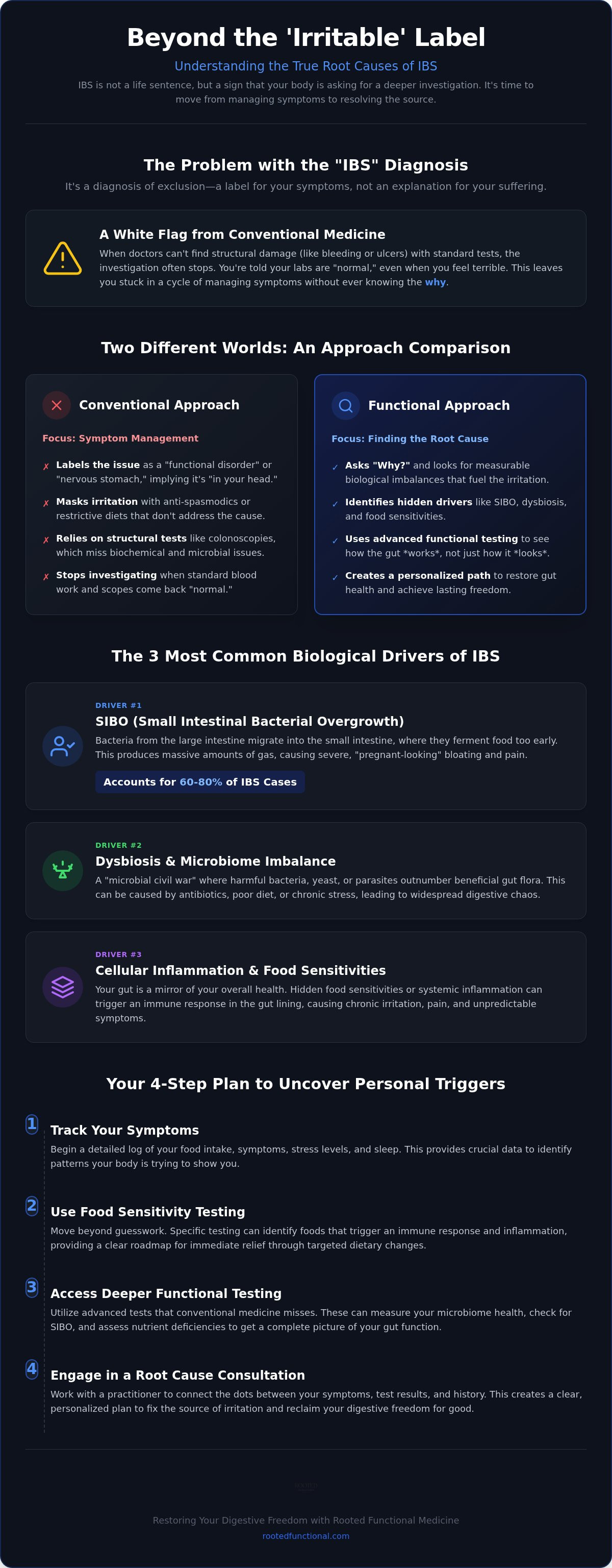
Investigating Your Gut: 4 Steps to Uncover Your IBS Triggers
You don't have to stay in the dark. Finding what cause ibs disease requires a structured investigation. It's about becoming a detective of your own body. Most people just wait for symptoms to happen and hope they go away. We want you to start watching why they happen. By following a clear path, you can move from "unexplained" irritation to a targeted plan for relief. This process isn't about guessing. It's about gathering data that your conventional doctor likely overlooked.
Step 1: Track your symptoms and timing. Notice exactly when the bloating or pain starts. Is it 30 minutes after a meal or 3 hours later?
Step 2: Eliminate the usual suspects. Remove common inflammatory triggers like gluten and dairy for a set period. This calms the immune system while we dig deeper.
Step 3: Order advanced functional lab work. Use breath and stool testing to identify SIBO, dysbiosis, or hidden infections.
Step 4: Build a personalized restoration protocol. Work with a functional practitioner to fix the specific imbalances found in your labs.
The Power of a Symptom Audit
Timing matters. It tells a story about where the dysfunction lives. If you feel pressure or bloating 30 minutes after eating, the issue is likely in your upper GI tract. This often points to low stomach acid or a lack of digestive enzymes. If the irritation hits 2 or 3 hours later, the trouble is deeper in the small intestine. This is a classic sign of SIBO. You should also watch for non-digestive clues. Brain fog, skin rashes, and sudden fatigue are all signals. They help us understand the full scope of what cause ibs disease in your unique system. While you work to uncover these causes, you can learn more about using Enterosgel as a drug-free way to relieve the immediate discomfort of bloating and urgency.
Healing your gut is a multi-layered process. Many people turn to the Low FODMAP diet as a permanent solution. While it can reduce symptoms, it's only a temporary band-aid. It manages the irritation by starving your bacteria, but it doesn't fix the underlying overgrowth. A true restoration protocol is more comprehensive. We focus on removing the "bad" bugs and toxins first. Then, we replace the enzymes your body is missing. Finally, we reinoculate the gut with the specific beneficial bacteria you need. This isn't a one-size-fits-all approach. It's a map designed specifically for your biochemistry. Ready to stop guessing? Book your Root Cause Consultation today.
Restoring Your Digestive Freedom with Rooted Functional Medicine
Dr. Adrienne Guthrie understands your struggle because she has lived it herself. She built Rooted Functional Medicine to be a sanctuary for those failed by the conventional system. We don't stop at a label. We dig until we find what cause ibs disease to disrupt your life. This is about more than just avoiding "trigger" foods. It is about restoring the biological integrity of your gut. You deserve a practitioner who listens, validates your pain, and offers a clear way out. We don't just want to help you survive your symptoms. We want to help you thrive without them.
Our process is built on clinical confidence and deep empathy. We use advanced functional testing to see what others miss. We look at your hormones, your microbiome, and your cellular health. This data allows us to build a protocol that is as unique as your DNA. We don't use symptom-masking drugs that only provide temporary relief. We use natural, science-backed interventions to restore balance. This approach doesn't just help you feel better today. It builds a foundation for lifelong wellness. You aren't just another patient file; you are a person ready to reclaim your health.
A Personalized Path to Gut Health
Our approach is built on data, not guesses. We use your unique lab results to create a roadmap that is yours alone. This isn't a standard prescription you'd find at a typical clinic. It is a targeted plan to reduce inflammation and restore cellular function. Because we offer secure telehealth, you can access this level of expert care from anywhere in the United States. We meet you where you are, literally and figuratively. We've seen patients who were told they'd never eat normally again find total freedom. It starts with looking at the microbiome, the immune system, and the gut barrier as one connected system.
Your First Step Toward Lasting Relief
IBS is a symptom. It is a sign that something is out of balance. It is not a life sentence. You've likely spent years feeling dismissed or overlooked. You've been told your labs are normal while your life feels anything but. We are here to tell you that there are real answers available. You can move from the constant anxiety of symptom management to the confidence of root cause resolution. We have the tools to decode what cause ibs disease in your specific environment. You can reclaim your time, your energy, and your relationship with food. Take the first step toward healing; schedule your consultation.
Take the Final Step Toward Digestive Freedom
You don't have to accept a life of simply managing your irritation. We've explored how moving beyond a diagnosis of exclusion allows you to finally understand what cause ibs disease in your unique body. Whether your symptoms are driven by SIBO, microbiome dysbiosis, or cellular inflammation, these are measurable imbalances that we can address. You've been told your labs are normal for too long. It's time to look deeper.
Dr. Adrienne Guthrie, named Best Emerging Leader in Functional & Natural Medicine 2025, provides the empathetic, award-winning care you deserve. Our protocols rely on advanced functional lab testing to uncover the invisible drivers of your pain. Thanks to nationwide telehealth, you can access this investigative approach from the comfort of your home. You've spent enough time as a prisoner to your symptoms. It's time to start a protocol that actually works.
Start your journey to gut health-Book your Root Cause Consultation
You aren't alone in this struggle. Your body has an incredible capacity to heal when it's given the right map. Let's find your path to lasting relief together. You are worth the effort it takes to feel well again.
Frequently Asked Questions
Is IBS a real disease or just a label for gut pain?
IBS is a clinical label rather than a specific disease with a single known cause. Doctors use it when they find no structural damage during tests like colonoscopies. While your pain is very real, the diagnosis itself doesn't tell you what cause ibs disease in your body. It simply confirms your gut is irritated. We view it as a starting point for investigation rather than a final answer for your symptoms.
Can SIBO be the actual cause of my IBS symptoms?
SIBO is frequently the primary driver of the bloating and gas associated with this condition. Research indicates that a large majority of patients labeled with IBS actually have bacterial overgrowth in their small intestine. These bacteria ferment your food prematurely, creating the pressure you feel. When we treat the overgrowth, the irritable symptoms usually resolve because we've addressed the biological source of the fermentation and gas production.
Why do my IBS symptoms flare up even when I eat healthy?
Healthy is relative to your specific gut ecosystem. Many nutritious foods like onions, garlic, and cauliflower are high in fermentable fibers. If you have an underlying bacterial imbalance, these foods feed the opportunistic bugs. This creates gas and inflammation regardless of how clean your diet is. We use Food Sensitivity Testing to find exactly which healthy foods are acting as personal triggers for your unique system during the healing process.
What is the difference between an IBS trigger and a root cause?
A trigger is the immediate event that causes a flare, like a stressful meeting or a spicy meal. A root cause is the underlying dysfunction that makes your gut reactive in the first place. For example, stress might trigger pain, but the root cause could be an infection or leaky gut. We focus on fixing the root cause so that everyday triggers no longer have the power to disrupt your life or bathroom habits.
How does stress actually affect my IBS according to functional medicine?
Leaky gut, or intestinal permeability, is a major contributor to digestive distress. When the lining of your gut becomes too porous, undigested food particles and toxins enter your bloodstream. Your immune system reacts by creating systemic inflammation. This often manifests as the unpredictable reactions and food fears common in those searching for what cause ibs disease. Restoring the integrity of this barrier is essential for lasting digestive freedom and immune stability.
How long does it typically take to see results with a functional medicine approach?
Every body heals at a different pace. Many of our patients begin to feel a shift in their bloating and energy levels within the first few weeks of starting their protocol. However, deep cellular repair and microbiome rebalancing typically take three to six months. We prioritize sustainable, natural healing over quick fixes. This ensures that once your symptoms are gone, they stay gone for the long term because the environment has changed.
Does functional medicine for IBS require a lifelong restrictive diet?
No, the goal is actually the opposite. While we may use a temporary elimination period to calm inflammation, our ultimate objective is to expand your diet. We want you to enjoy a wide variety of foods without fear of a reaction. By fixing the root dysfunction and restoring your microbiome, we help your gut become resilient again. You shouldn't have to live your life on a restrictive list once the underlying irritation is resolved.


