Food Sensitivity and Autoimmune Disease: How Precision Testing Stops the Flare
What if the "healthy" foods you're eating are actually acting like software errors in your immune system? It's exhausting to live with persistent inflammation while being told by conventional doctors that diet doesn't matter. You've likely tried every protocol from Keto to AIP, yet the link between food sensitivity and autoimmune disease remains unaddressed. We understand that frustration. You deserve more than just a way to mask your symptoms. You deserve a path to true resolution.
Identifying your specific triggers through precision testing allows us to calm your immune system at the root. In this article, we'll show you how to move past conflicting dietary advice and uncover a personalized roadmap for healing. You'll learn how to distinguish safe foods from triggers, reduce systemic inflammation, and finally build a protocol that restores your cellular health for good. It's time to stop guessing and start finding real answers.
Table of Contents
The Biological Link Between Food Sensitivity and Autoimmune Disease
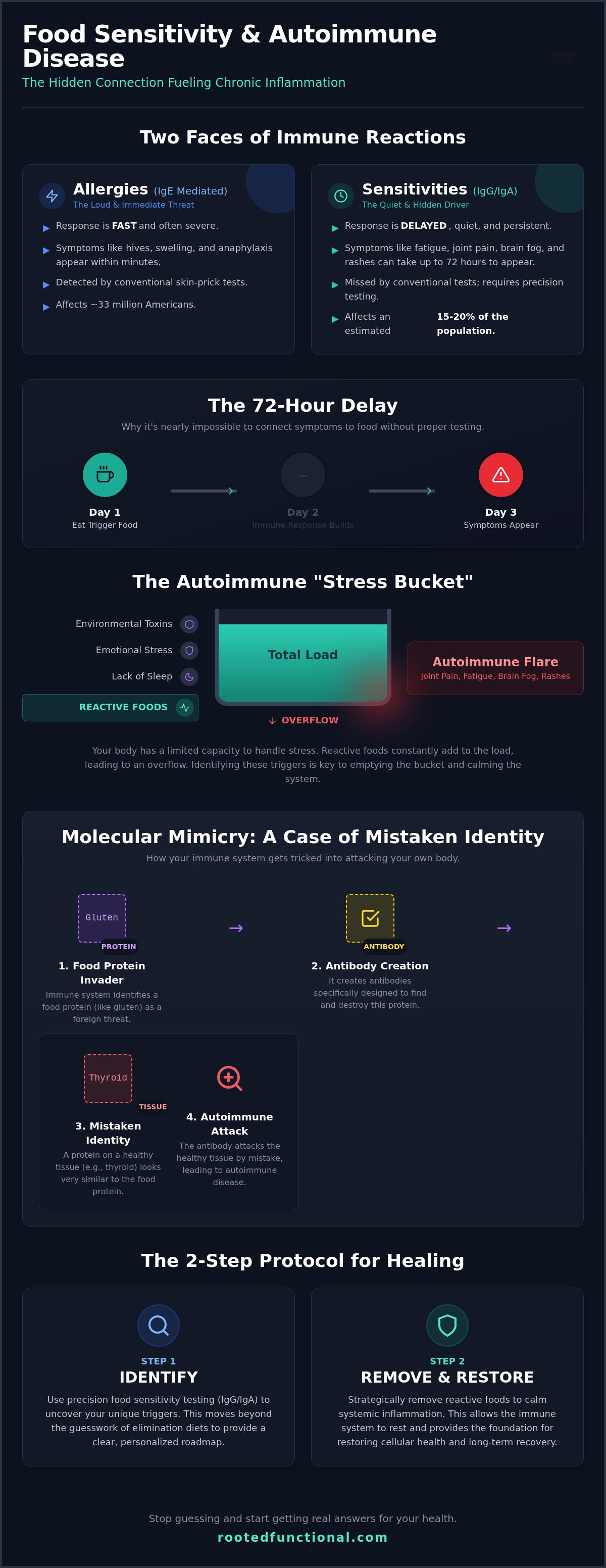
When most people think of food reactions, they imagine hives or immediate swelling. That is an IgE-mediated allergy. But for those struggling with chronic illness, the real culprit is often a hidden, delayed response. This is the core connection between food sensitivity and autoimmune disease. While allergies are loud and instant, sensitivities are quiet and persistent.
Food sensitivities involve IgG and IgA antibodies. Unlike an allergy, these reactions don't happen instantly. They can simmer for hours or even days. This keeps your immune system in a state of constant, high alert. It never gets a chance to rest or repair. Instead, it stays busy hunting down food proteins it has mistakenly labeled as invaders. This chronic activation is a primary driver of the inflammation that keeps you feeling stuck.
Before we dive deeper, it helps to understand the basics. What is an autoimmune disease? At its simplest, it's a case of mistaken identity where the body attacks its own tissues. Continuous exposure to reactive foods acts as constant fuel for these autoimmune fires.
Think of your body's capacity for stress like a bucket. Environmental toxins, lack of sleep, and emotional stress all add water to that bucket. When you eat foods your body can't tolerate, you're pouring more water in. Eventually, the bucket overflows. That overflow is your flare. By identifying these triggers, we can finally start to empty the bucket and give your body the space it needs to heal.
Why Your Immune System Misidentifies Food as a Threat
Your adaptive immune system is designed to be a master of recognition. It learns to identify foreign proteins to protect you from viruses and bacteria. However, when your system is stressed or overloaded with toxins, its judgment falters. Repetitive exposure to the same proteins, like gluten or dairy, can cause the system to become sensitized. It stops seeing food as nourishment and starts seeing it as a threat. This confusion is often the first step toward a full-blown autoimmune response.
Common Symptoms of Food-Triggered Autoimmune Flares
The damage isn't just in your gut. Because the immune response is systemic, symptoms of food sensitivity and autoimmune disease can show up anywhere in the body. You might experience throbbing joint pain, stubborn skin rashes, or crushing fatigue. Many patients struggle with debilitating brain fog, which is often neuroinflammation triggered by the gut. The most frustrating part is the delay. A reaction can take up to 72 hours to appear after eating the trigger food. This makes it nearly impossible to identify your triggers without professional, precision testing.
Why Conventional Allergy Tests Miss Your Autoimmune Triggers
Have you ever been told your lab results are "perfect" while your body feels like it's falling apart? It's a common story. Conventional medicine is excellent at identifying life-threatening allergies, but it often stops there. If your skin-prick test comes back negative, you're usually told that food isn't the problem. For someone navigating the complex world of food sensitivity and autoimmune disease, this answer is not just incomplete. It's misleading.
Standard allergy tests only look at one specific part of your immune system. They ignore the delayed pathways that actually drive chronic flares. While approximately 33 million Americans live with traditional food allergies, research suggests that 15 to 20 percent of the population struggles with food sensitivities. These sensitivities don't cause immediate hives. They cause a slow, systemic burn that conventional testing simply isn't designed to see. Precision testing is the only way to move beyond this guesswork.
IgE vs. IgG: The Two Sides of the Immune Coin
Your immune system has different "branches" that react to food. Conventional allergists focus on IgE antibodies. These are responsible for immediate, anaphylactic responses. Think of a peanut allergy. It's fast, loud, and dangerous. However, autoimmune flares are more often driven by IgG and IgA antibodies. These are the "hidden" triggers. They create a delayed inflammatory response that can take days to manifest. Because these reactions are slow, you can't easily link your lunch on Monday to your joint pain on Wednesday. You need to test for both sides of the coin to understand why your body is attacking itself. If you're tired of feeling dismissed, a Root Cause Consultation can help you finally see the full picture of your immune health.
The Problem with 'Guesswork' Elimination Diets
Many patients turn to the Autoimmune Protocol (AIP) or other restrictive diets to find relief. While these can be helpful, they are often a blunt instrument for a delicate problem. Elimination diets rely on manual tracking and guesswork. They can take months of frustrating trial and error. Even worse, you might be cutting out "healthy" foods like spinach, almonds, or kale that are actually your specific triggers. This leads to two major problems. First, you might still be flaring because you haven't found the right trigger. Second, you risk serious nutrient deficiencies by being overly restrictive. Precision testing stops the cycle of malnutrition and reveals exactly which foods are safe for your unique cellular health. We don't want you to eat less. We want you to eat right.
Molecular Mimicry: How Your Diet Becomes an Immune Threat
If you’ve ever wondered why your symptoms persist despite a "perfect" diet, the answer may lie in molecular mimicry. This is a biological case of mistaken identity. Your immune system is designed to be a vigilant sentry. It scans for foreign proteins that look like threats. Sometimes, the amino acid sequences in certain foods look almost identical to the proteins in your own organs. When your immune system attacks these food particles, it inadvertently begins attacking your own healthy tissue. This confusion is a major driver of food sensitivity and autoimmune disease.
The "Gluten-Thyroid" connection is the most famous example of this mechanism. The protein structure of gluten closely resembles the protein structure of your thyroid gland. If your body has flagged gluten as an enemy, your immune system may begin to "fire" at your thyroid every time you eat a piece of bread. This keeps you in a state of chronic inflammation. Intestinal permeability acts as the primary gateway for autoimmune progression by allowing undigested food proteins to bypass the gut barrier and enter systemic circulation, where they trigger chronic immune activation.
The 'Leaky Gut' Gateway
Your gut lining is meant to be a selective barrier. It uses "tight junctions" to decide what enters your bloodstream. However, factors like chronic stress, exposure to glyphosate, and the consumption of gluten can cause these junctions to pry open. This is leaky gut. When these barriers fail, undigested food particles escape into your blood. Your immune system sees these particles as invaders and begins a "search and destroy" mission. This doesn't just affect your digestion. Because the gut and the brain are deeply connected, a leaky gut often leads to a leaky blood-brain barrier. This is why so many patients experience debilitating brain fog alongside their physical flares.
Cross-Reactivity: When One Food Triggers a Reaction to Another
Sometimes, removing the primary trigger isn't enough. Your immune system can become so sensitized that it starts reacting to "copycat" proteins in other foods. This is called cross-reactivity. For example, if you are sensitive to gluten, your body might also react to coffee, chocolate, or corn because their protein structures are similar enough to "trick" your immune cells. This explains why some "safe" foods still cause symptoms. Testing for these specific cross-reactive proteins is a critical step in our Food Sensitivity Testing. We don't want you to guess which foods are safe. We want to find the specific data your body is trying to tell us. By uncovering these hidden cross-reactions, we can finally stop the immune system from overreacting and give your body the peace it needs to heal.
Using Food Sensitivity Tests for Your Healing Protocol
A roadmap is essential when your body feels like a battlefield. You don't need another generic diet. You need a personalized protocol based on your unique biology. We start by ordering a comprehensive functional food sensitivity panel that looks at IgG and IgA markers. This data allows us to identify exactly which proteins are triggering your immune system. Once we understand the link between food sensitivity and autoimmune disease, we can stop guessing and start healing.
Once we have your results, we remove high-reactive foods for a set period, usually 90 days. This gives your immune system a much-needed break. During this time, we don't just leave you with a list of "no" foods. We implement a targeted gut-healing protocol to seal the intestinal lining. Finally, we move into a systematic reintroduction. This helps us determine your long-term tolerance and build a sustainable lifestyle. Doing this alone is overwhelming. Professional guidance ensures you don't miss the nuances of your recovery. A clear list. A proven plan. A life without flares.
Interpreting Your Lab Results
Most functional labs use a simple "Red, Yellow, Green" light system. Green foods are safe. Yellow foods should be limited. Red foods are your primary triggers. If your results come back showing a high reaction to almost everything, don't panic. This usually points to a severe leaky gut rather than a sudden allergy to 50 different foods. It means your gut barrier is so permeable that almost anything you eat is leaking into your bloodstream. We prioritize removing the most inflammatory "red" foods first to provide maximum relief while we focus on repair. If you're ready to see what your biology is telling you, it's time to book your Root Cause Consultation today.
Healing the Gut While You Rest
Simply avoiding trigger foods isn't enough to "cure" a sensitivity. If you don't fix the underlying intestinal permeability, new sensitivities will just take their place. We use specific nutrients to support gut lining repair, such as L-glutamine, collagen, and zinc carnosine. These act as the "bricks and mortar" for your digestive tract. We also use high-quality probiotics and prebiotics to diversify your microbiome. A diverse gut is a resilient gut. This combination of removal and restoration is what allows your immune system to finally find its balance. We're looking for more than symptom management. We're looking for cellular peace.
Beyond the Plate: The Rooted Functional Medicine Approach
Understanding the complex relationship between food sensitivity and autoimmune disease is a massive breakthrough for most patients. But for many, it's just one piece of a larger puzzle. You might have cleared your pantry of triggers and still feel the familiar pull of an impending flare. This happens because inflammation rarely has a single source. At Rooted Functional Medicine, Dr. Adrienne Guthrie looks beyond your plate to find why your immune system is overreacting in the first place. We don't just hand you a list of foods to avoid. We integrate your specific results into our comprehensive Autoimmune Solutions Program. This is a lab-guided, personalized protocol designed to stop the guesswork and start the restoration of your cellular health.
The Root Cause Consultation: Your First Step
Your journey toward wellness begins with a deep dive into your history. We want to hear the story your other doctors didn't have time to listen to. During your Root Cause Consultation, we look at the hidden drivers that keep your body in a state of high alert. While addressing food sensitivity and autoimmune disease is essential, we also use advanced functional labs to uncover issues that standard blood work misses. This might include heavy metal toxicity, latent viral infections, or chronic mold exposure. By identifying these layers, we can build a strategy that addresses the internal environment your cells live in. It's about moving from a state of survival to a state of thriving.
A Personalized Path to Lasting Relief
Our approach focuses on cellular restoration, not just symptom management. We believe that when you give the body the right conditions and remove the obstacles, it knows how to heal itself. This is personal for us. Dr. Guthrie has walked through the fire of chronic illness herself. She knows the fear of a new symptom and the exhaustion of being dismissed by the conventional system. Because of this lived experience, she leads with both clinical expertise and maternal warmth. We offer nationwide telehealth consultations. This means you can access this level of specialized, natural care from anywhere in the country. You've spent enough time managing your symptoms. It's time to uncover the root cause. Stop guessing and start healing today.
Take the First Step Toward Cellular Peace
Living in a constant state of inflammation is exhausting. You’ve likely been told that your diet doesn't matter, yet your body tells a different story every time you flare. By understanding the deep connection between food sensitivity and autoimmune disease, you can finally stop the guesswork. Precision testing reveals the specific "immune software errors" that generic protocols miss. We move beyond masking symptoms to provide a roadmap for true cellular restoration.
Led by Dr. Adrienne Guthrie, named Best Emerging Leader in Functional Medicine 2025, our practice offers 100% natural, lab-based protocols designed for your unique biology. These personalized programs are available nationwide through our convenient telehealth platform. You deserve a guide who has walked this path and knows how to uncover the hidden drivers of your illness. It is time to reclaim your health and your life.
Book Your Root Cause Consultation and Start Your Healing Journey today. Real answers are within reach. We are here to help you heal.
Frequently Asked Questions
Can food sensitivity testing really help with my autoimmune disease?
Yes, precision testing identifies the specific proteins that keep your immune system in a state of constant alert. When we pinpoint these triggers, we can strategically remove the "fuel" from your autoimmune fire. This approach moves beyond symptom masking and focuses on cellular restoration. By calming the systemic inflammation driven by food sensitivity and autoimmune disease, you give your body the space it needs to begin the repair process.
What is the difference between a food allergy and a food sensitivity?
A food allergy is an immediate, often life-threatening IgE immune response like hives or swelling. In contrast, a food sensitivity is a delayed IgG or IgA reaction that may take up to 72 hours to appear. While allergies are loud and fast, sensitivities are quiet and chronic. They drive the persistent, systemic inflammation that often underlies autoimmune flares. Conventional tests usually only check for allergies, missing these critical "hidden" triggers entirely.
How long does it take to see results after removing sensitive foods?
Most patients begin to feel a noticeable reduction in systemic inflammation within two to four weeks of removing their specific triggers. However, deep cellular healing and the reversal of chronic symptoms often take longer. We typically recommend a 90-day protocol to allow the gut lining to repair and the immune system to fully reset. Consistency is key during this window to ensure your "inflammation bucket" has time to empty.
Is an elimination diet better than a food sensitivity test?
Elimination diets rely on guesswork and can take months of frustrating trial and error. They often lead to unnecessary restriction or the accidental inclusion of "healthy" foods that are actually your specific triggers. Precision testing provides immediate, lab-based data so you don't have to guess. It identifies exactly which proteins are causing a reaction. This saves time, prevents potential nutrient deficiencies, and provides a clear, actionable roadmap for your unique biology.
Can food sensitivities be reversed once the gut is healed?
Many food sensitivities can be reversed once we address the underlying intestinal permeability, or "leaky gut." When the gut barrier is sealed and the immune system is no longer in a hyper-reactive state, you may be able to reintroduce certain foods without a flare. Our protocol includes a systematic reintroduction phase to test your long-term tolerance. The goal is a diverse, resilient microbiome that can process a wide variety of whole foods safely.
Why didn't my regular doctor order these food sensitivity tests?
Conventional medicine is primarily designed to manage acute conditions and life-threatening allergies. Most regular doctors are not trained in the nuances of delayed IgG or IgA immune responses. They often view food as irrelevant to autoimmune progression if a standard allergy test comes back negative. Functional medicine practitioners look deeper. We focus on root-cause resolution and cellular health, using advanced labs to uncover the hidden drivers of your chronic inflammation.
What are the most common food triggers for autoimmune flares?
While gluten and dairy are frequent culprits due to molecular mimicry, triggers are deeply individual. You might react to common "health" foods like spinach, almonds, or eggs. Other frequent triggers include:
Corn and soy proteins
Nightshades like peppers or tomatoes
Specific grains or legumes
Precision testing is essential because your body's "immune software" is unique. We find exactly what is triggering your specific system so you can stop the guessing.
Do I have to avoid these foods forever?
Not always. Many "yellow" or moderately reactive foods can be enjoyed again once your gut is healed and your systemic inflammation is low. However, some "red" or highly reactive triggers, particularly those like gluten that closely mimic your own tissues, may need to be avoided long-term to prevent a relapse. We guide you through a systematic reintroduction process to determine which foods are safe for your body to handle in the future.


